
Nurse Wellness Training for Geriatric Populations
Last Updated: October 23, 2026
Quick Summary
Nurse wellness training for geriatric populations prepares nurses to deliver fall prevention, strength and flexibility work, sleep and pain support, cognitive engagement, and hydration coaching to aging adults. It also builds advanced competencies in multidimensional assessment, communication, and wellness coaching. This training positions nurses to lead wellness-focused geriatric care as baby boomers demand quality of life and independence.
- Baby boomers are the largest aging cohort in history and are living longer than any generation before them.
- The Indian Health Service’s 2025-2026 pilot year plans to support up to 20 Geriatric Nurse Fellows.
- A 2019 study found lifestyle wellness programs help prevent and manage chronic disease, yet few are designed for aging adults.
- A six-step curriculum moves from geriatric foundations and ageism to measurement and follow-up.
- Pair every training session with one follow-up check two weeks later to help skills stick.
Table of Contents
- Why Nurse Wellness Training for Geriatric Populations Matters Now
- Core Geriatric Nursing Interventions Every Wellness Program Needs
- Designing Older Adult Wellness Programs That Older Adults Actually Want
- Geriatric Nurse Practitioner Training and Advanced Competencies
- Therapeutic Yoga for Older Adults: Adapting Practice to Real Bodies
- Building a Step-by-Step Wellness Training Curriculum for Nurses
- Measuring Training Effectiveness and Sustaining Nurse Engagement
- Frequently Asked Questions
Why Nurse Wellness Training for Geriatric Populations Matters Now
The numbers tell a story nurses already feel on every shift. America’s older population is swelling, and the nurses who care for them are stretched thin. That is exactly why nurse wellness training for geriatric populations has moved from a nice-to-have to a genuine career opportunity.
Here is the shift most people miss. Baby boomers are not quietly aging into passive patients. They are demanding quality of life, independence, and care that treats them as whole people. They want to move, breathe, sleep, and stay engaged with life. Nurses who can deliver that kind of care are in short supply.
At YogaNurse®, we have watched this gap widen for years. The nurses who step into it find something rare: meaningful work that does not grind them down.
The Baby Boomer Opportunity for Nurses
Baby boomers are the largest aging cohort in history, and they are living longer than any generation before them. They are also asking for something different from care. They want to stay strong, mobile, and mentally sharp.
That demand creates room for nurses to lead. Wellness-focused geriatric care lets you build a specialty, work with patients who value what you offer, and step away from the physical toll of bedside nursing.
The training pipeline is still catching up. The Indian Health Service’s 2025-2026 pilot year plans to support up to 20 Geriatric Nurse Fellows, a small but telling signal that formal geriatric training is expanding Indian Health Service Geriatric Nurse Fellowship Program. Twenty fellows will not meet the need. Nurses who train themselves will.
The baby boomer wave is not a threat to nursing. It is the biggest opening for nurse-led wellness work in a generation.
Core Geriatric Nursing Interventions Every Wellness Program Needs
Any solid wellness program for older adults rests on a few core interventions. These are the geriatric nursing interventions that actually change daily life for aging patients:
- Fall prevention and balance work to protect mobility and confidence
- Strength and flexibility training adapted to real bodies
- Sleep and relaxation support for rest and recovery
- Cognitive engagement through memory and social activities
- Pain management using gentle, non-drug approaches
- Hydration and nutrition coaching for energy and healing
What most guides miss is the order. Nurses tend to jump to exercise first. In practice, sleep and pain often decide whether a patient can engage at all. Fix those, and the rest follows.
A 2019 study in research on aging adults’ wellness preferences found that lifestyle wellness programs help prevent and manage chronic disease, yet few are designed for aging adults. That gap is your opening.
Designing Older Adult Wellness Programs That Older Adults Actually Want
Older adult wellness programs fail when they are built for the nurse’s convenience instead of the patient’s life. The fix is simpler than it sounds: ask what they want, then build around it. But asking is only the first step. The gap most training programs miss is a concrete, repeatable process for co-designing wellness activities with older adults, especially those with cognitive, sensory, or mobility limitations.
Start with a structured discovery phase. Before you plan a single session, spend two weeks gathering input through three channels: (1) one-on-one conversations with residents or patients, (2) a short anonymous survey (large print, verbal option available), and (3) observation of existing daily routines. Look for what people already enjoy and what they avoid.
Next, adapt every activity across four dimensions. For cognitive changes, keep sequences short (5-7 minutes), use clear one-step cues, and repeat the same opening and closing routine each session. For sensory changes, speak slowly and face the person, use visual demonstrations alongside verbal instructions, and reduce background noise. For mobility limits, offer seated versions of every movement and keep chairs arranged in a semicircle so no one feels singled out. For energy limits, build in rest breaks every 10 minutes and never push past a patient’s reported fatigue.
A 2019 study in research on aging adults’ wellness preferences found that lifestyle wellness programs help prevent and manage chronic disease, yet few are designed for aging adults. That gap is your opening, but only if you replace generic ‘person-centered’ language with a repeatable design process.
Build one small pilot group before designing a full program. Watch who shows up, what they skip, and what they ask for. Then run a 10-minute debrief with participants: ‘What worked? What felt too hard? What would you change?’ That feedback is worth more than any curriculum template.
Geriatric Nurse Practitioner Training and Advanced Competencies
Geriatric nurse practitioner training is where clinical authority grows. NPs who work with older adults need skills that go beyond diagnosis and prescribing. They need to assess the whole person.
A 2024 review on training health professionals to assess physical, mental, and social health focused on exactly this: teaching clinicians to assess physical, mental, and social health together. That three-part lens is the heart of good geriatric care.
The competencies that matter most:
- Multidimensional assessment of body, mood, and social support
- Communication that respects dignity and independence
- Care planning built around patient goals, not just conditions
- Wellness coaching that supports healthy aging
- Team leadership across caregivers and families
Nurses who master these skills stop being “just a nurse” in the eyes of families. They become the person everyone trusts.
Therapeutic Yoga for Older Adults: Adapting Practice to Real Bodies
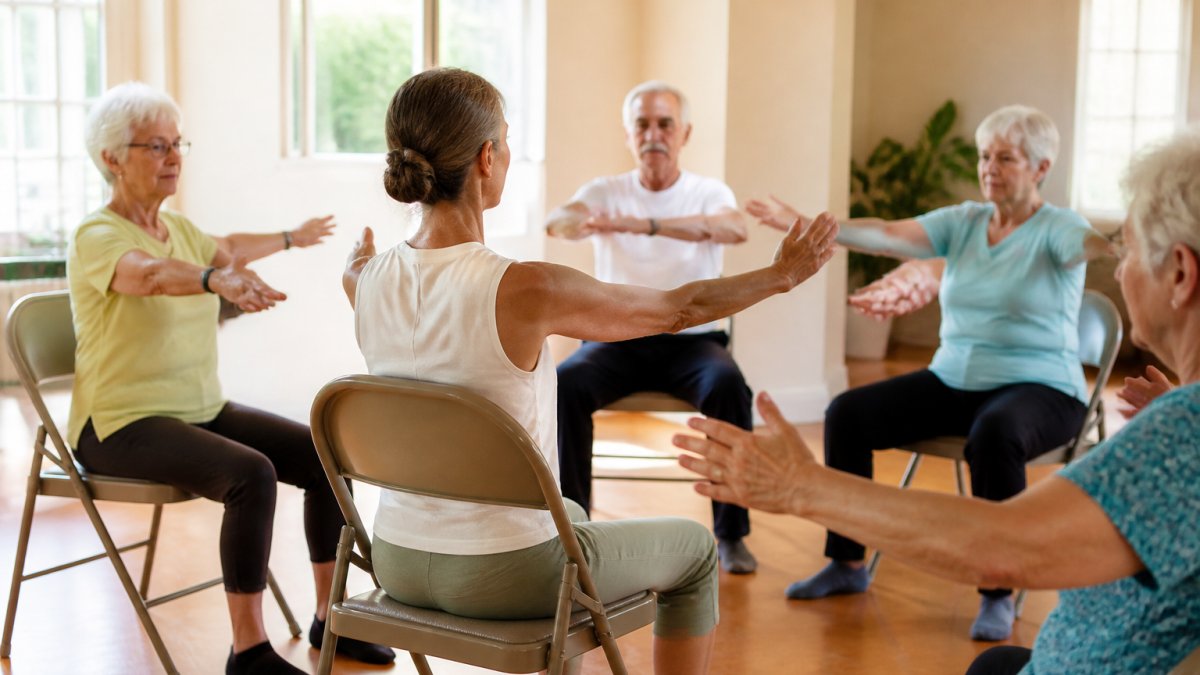
Therapeutic yoga for older adults works only when it adapts to real bodies. That means chairs, walls, and breath, not complicated poses.
A 2019 article by A. Ilgaz and coauthors argued that health professionals should learn integrative nursing principles and apply them to improve older adults’ health and well-being integrative nursing principles for older adults. Yoga fits that frame when it is taught with care.
Adapt practice around these needs:
- Cognitive changes: short sequences, clear cues, repetition
- Sensory changes: slower speech, visual demonstrations, quiet rooms
- Mobility limits: seated poses, chair support, wall assistance
- Energy limits: brief sessions with rest built in
The goal is never a perfect pose. It is steadier breathing, less pain, and a patient who feels capable.
Skipping a proper intake before teaching movement can put a fragile patient at risk. Check with the care team first, and stop any practice that causes pain or dizziness.
Building a Step-by-Step Wellness Training Curriculum for Nurses
A wellness training curriculum for nurses works best when it moves from knowledge to practice in clear steps. Here is a structure you can follow.
| Step | Focus | Time | Outcome |
|---|---|---|---|
| 1 | Geriatric foundations and ageism | 2 hours | Respectful, person-centered mindset |
| 2 | Multidimensional assessment | 3 hours | Physical, mental, social screening |
| 3 | Core interventions | 4 hours | Fall, sleep, pain, and mobility skills |
| 4 | Adapted therapeutic yoga | 4 hours | Safe seated and supported practice |
| 5 | Communication and dignity | 2 hours | Stronger patient engagement |
| 6 | Measurement and follow-up | 2 hours | Clear outcomes and feedback |
Start with mindset. Ageism quietly undermines care, and naming it changes how nurses listen. Then build skills, and finish with measurement so you can prove what worked.
A 2023 study by T. Doan and coauthors found that a life-review assignment helped student nurses learn about aging both personally and professionally. Reflection belongs in the curriculum, not just technique.
If you would rather not build every module from scratch, the YogaNurse Ready to Teach Healthy Aging Collection for Nurses offers ready-made healthy aging sessions you can adapt to your setting, and The YogaNursing Essentials covers the foundational integrative nursing principles behind them.
Measuring Training Effectiveness and Sustaining Nurse Engagement
Training that is never measured quietly disappears. But most programs track the wrong things, or track nothing at all. The gap competitors miss is a simple, repeatable measurement framework that connects baseline assessment to follow-up and ties training outcomes to patient outcomes.
Start with a baseline before any training begins.
Then measure at three points: immediately after training (knowledge check), two weeks later (skills check via direct observation), and eight weeks later (patient outcome review). For the skills check, use a short competency checklist, for example, ‘demonstrates seated chair exercise with proper cueing’ or ‘completes a multidimensional assessment including social support.’ A common pattern is that nurses pass the knowledge check but struggle with the two-week skills check. That is your signal to add a refresher session.
Sustaining engagement requires more than measurement. Pair every training session with one follow-up check two weeks later. Skills stick when someone asks how it went.
Finally, connect training to patient outcomes. Track falls, pain reports, sleep quality, and attendance in wellness sessions before and after training. Share those numbers with your team monthly. Nurses stay engaged when they can see that their new skills are changing lives, not just completing a checklist.
Pair every training session with one follow-up check two weeks later. Skills stick when someone asks how it went.
Frequently Asked Questions
How can nurses support wellness in older adults?
Start with what the person values. A 2019 study by Talley and coauthors found that lifestyle wellness programs can help prevent and manage chronic disease, yet few are designed for aging adults, so nurses who adapt activities to real preferences fill a genuine gap. Practical steps include multidimensional assessment of physical, mental, and social health, short movement and breathing sessions scaled to mobility and sensory needs, and regular check-ins on goals like independence and quality of life. Nurse wellness training that covers these skills makes the work repeatable rather than improvised.
What are the key geriatric nursing interventions for older adults?
Geriatric nursing interventions center on function and dignity: fall and mobility support, medication review, hydration and nutrition prompts, cognitive and sensory accommodations, and social engagement. A 2024 review in PubMed Central focused on training healthcare professionals to assess physical, mental, and social health together, which reflects how older adult care actually works. Add relaxation and pain-relief practices that suit the person’s body, and document what changed. The strongest interventions are the ones a nurse can teach, repeat, and hand over to caregivers.
How can nurses become geriatric nurse practitioners?
The path runs through graduate education: an accredited master’s or doctoral program with a geriatric or adult-gerontology primary care focus, supervised clinical hours, and national certification, followed by state licensure as an NP. Check your state board of nursing for the exact requirements because they vary. The Indian Health Service’s Geriatric Nurse Fellowship shows how structured older-adult training is expanding: for the 2025-2026 pilot year it plans to support up to 20 fellows in a program that includes a core course on older-adult care principles.
What training helps nurses provide holistic care to older adults?
Look for training that combines assessment skills with mind-body practice. Ilgaz and coauthors argued in 2019 that health professionals should learn integrative nursing principles and apply them to older adults’ health and well-being, and Doan and coauthors reported in 2023 that a life-review assignment helped student nurses learn about aging personally and professionally. Programs that teach therapeutic yoga for older adults alongside communication, ageism awareness, and caregiver engagement give nurses tools they can use in long-term care, residential care, home health, or their own wellness practice.
Geriatric care is growing fast, and nurses who prepare now will lead it. If you want to bring therapeutic movement and holistic wellness into older adult care, YogaNurse® can help. Our Ready to Teach Healthy Aging Collection gives you session plans built for real bodies, and our YogaNursing Essentials training grounds you in evidence-informed, nurse-led practice. Explore what’s possible and start building the geriatric wellness work you were meant to do.


FREE GUIDE!
Get powerful curated tips on the art of nurses teaching yoga
In spirit of our upcoming training: YNYTT (Yoganurse Yoga Teacher Training), we are giving away this jam-packed guide full of wonderful curated tips that will help you become a highly effective & highly influential nurse yoga teacher.
